You Don't Need a Circle to Be Sacred: A Solitary Seeker's Guide to Deep Spiritual Practice

At some point, nearly every spiritually curious introvert has felt it: that specific guilt of sitting out yet another group ceremony, skipping the sound bath workshop, or quietly leaving a retreat brochure in the recycling bin. The wellness world, for all its talk of honoring your energy, has a surprisingly strong bias toward communal experience. Circles, cohorts, group containers, shared journeys — the message is everywhere, and it carries an implicit suggestion that if you're not doing this together, you might not be doing it right.
You are doing it right. You're just doing it differently.
Solitary spiritual practice has a lineage as old as spirituality itself. Hermits, monastics, desert mystics, contemplatives of every tradition — the idea that depth requires community is a modern wellness industry invention, not a spiritual truth. Some of the most profound inner work in human history has happened in silence, alone, without a facilitator or a group chat.
This is a guide for the seekers who already know this, and for the ones who are just beginning to give themselves permission.
Why Group Spaces Don't Work for Everyone
Let's be clear about something: this isn't about being antisocial or spiritually superior. Plenty of introverts have meaningful experiences in community settings. But for a significant number of people — especially those with social anxiety, trauma histories, or simply strong introversion — group spiritual spaces come with costs that can outweigh the benefits.
There's the performance pressure of sharing in circles. The way group energy can override your own intuition. The exhaustion of holding space for other people's processes when your own needs attention. The dynamic of strong personalities in workshops who subtly shape what "correct" spiritual experience looks like. The financial barrier of expensive retreats and multi-week programs that assume a certain kind of lifestyle.
For introverts, the recovery time from an intensive group spiritual experience can take days — and that's time and energy that could have gone into actual practice. When your spiritual life is primarily built around recovering from your spiritual life, something's off.
Building Your Own Sacred Container
The first and most important thing a solitary practitioner needs is a dedicated space — not necessarily a whole room, but a consistent physical anchor for their practice. This matters more than people realize. Your nervous system is deeply spatial; having a place that reliably signals "this is where I go inward" trains your body to drop into that state more easily over time.
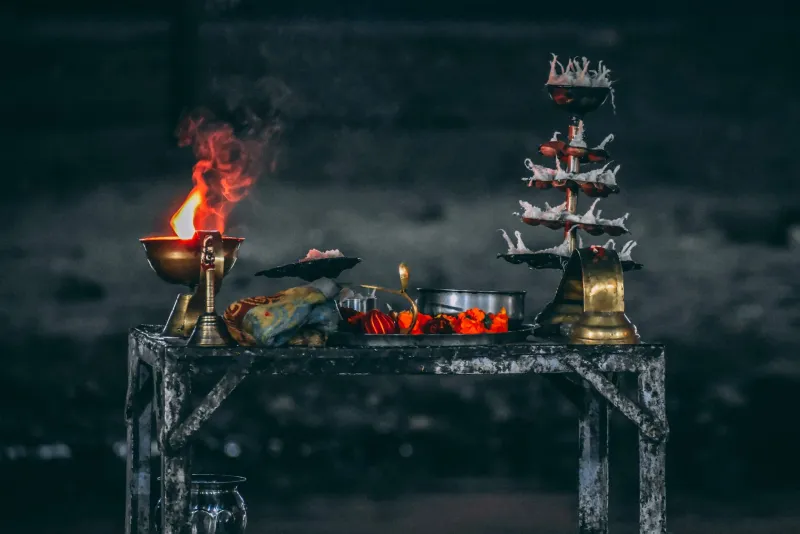
This doesn't have to be elaborate. A corner of your bedroom with a small surface for meaningful objects, a candle, and a few things that orient you — a stone, a plant, a photo, a card pulled from a deck — is genuinely enough. The altar isn't decorative; it's functional. It's a physical representation of your intention to show up for your inner life.
What goes on it should be personal and changeable. Let it evolve with your practice. Swap things out with the seasons. Add something when you're working through something specific. Remove what no longer resonates. Treat it less like a shrine and more like a living document of where you are spiritually right now.
Structuring a Practice That Actually Holds
One of the genuine advantages of group settings is accountability — someone else is expecting you to show up. Solo practitioners have to build that structure themselves, and it's worth being honest about how much structure you actually need.
Some people thrive with a morning ritual that never varies: the same sequence of journaling, breathwork, and a few minutes of stillness, every day, before anything else. Others need more flexibility, and a rigid routine becomes another thing to fail at. Know which one you are.
A few approaches that work particularly well for solitary practice:
Anchor practices over full routines. Instead of a 45-minute morning sequence you'll abandon by week two, choose one non-negotiable anchor — five minutes of intentional breathing, one tarot card pulled and considered, a single page of stream-of-consciousness writing. Do that thing every day, even when nothing else happens. Consistency in a small practice beats inconsistency in an ambitious one.
Seasonal rhythm as your calendar. Without a community to mark time with, the natural calendar becomes your container. The solstices, equinoxes, and cross-quarter days (Imbolc, Beltane, Lammas, Samhain) offer eight natural check-in points throughout the year. Use these as moments to review your intentions, release what isn't working, and set new ones. You don't need a group to make these transitions meaningful.
Reading as a practice, not just information-gathering. The lineage of solitary spirituality runs through books. Reading slowly — with a journal nearby, stopping to sit with what resonates — is a legitimate form of spiritual practice. The conversation between you and a text, when done with presence, can be as transformative as any workshop.
Accountability Without a Circle
The most common concern solitary practitioners raise is accountability — without a group, how do you stay honest with yourself? How do you avoid spiritual stagnation?
A few options that don't require surrendering your solitude:
A single spiritual friendship — one person you trust, who you check in with occasionally, with no agenda other than mutual honesty. This is different from a group. It's low-pressure, asynchronous if you need it to be, and it keeps you from disappearing entirely into your own echo chamber.
Periodic sessions with a spiritual director, therapist, or astrologer. These one-on-one relationships offer outside perspective without the group dynamic. Many practitioners find that a quarterly session with someone they trust is enough to keep their practice from calcifying.
Journaling with the intention of honest self-assessment. Not just recording experience, but questioning it. What have I been avoiding? Where am I going through the motions? What's actually shifting?
The Permission You've Been Waiting For
Your spirituality doesn't need witnesses to be real. It doesn't need a community container to be valid. It doesn't need a teacher, a cohort, or a group text to count.
The most sacred spaces are often the quietest ones — the predawn hour before anyone else is awake, the solo walk where you let your mind go where it needs to go, the evening ritual that no one else knows about. There is something profound about a practice that exists entirely for you, witnessed only by whatever you believe is listening.
Build it slowly. Build it honestly. Build it in a way that fits the actual shape of your life, not the version of spiritual practice that looks best on the internet.
That's not a compromise. That's integrity.