You Don't Need the Full Family Tree to Build an Ancestor Altar
Maybe you were adopted. Maybe your family never talked about where they came from. Maybe you know your grandmother's first name but nothing else. Maybe your lineage crosses so many borders and cultures that you're not sure which traditions you're even allowed to claim. Maybe your family history contains things — violence, erasure, trauma — that make the idea of honoring your ancestors feel genuinely complicated.
And yet here you are, drawn to the idea of an ancestor altar. Curious about what it would mean to acknowledge the people who came before you, even imperfectly, even incompletely.
Good. That curiosity is the beginning of the whole thing.
Why Ancestor Veneration Is Having a Moment (And Why That's Complicated)
Ancestor altars are appearing all over American homes right now — on TikTok, in spiritual shops, in the apartments of people who have never set foot in a church or temple. For many people, especially those who grew up disconnected from their cultural or spiritual roots, this practice offers something genuinely nourishing: a sense of continuity, of belonging to something larger than the self.
But as with many spiritual practices that cross cultural lines, it's worth approaching this with some care. Ancestor veneration isn't a monolith — it exists in West African traditions, Chinese ancestral rites, Japanese Obon, Mexican Día de los Muertos, European folk practices, and countless Indigenous traditions across the globe. These aren't interchangeable. They carry specific cosmologies, protocols, and meanings within their home cultures.
This guide isn't asking you to appropriate any specific tradition. It's offering a framework for building something intentional and respectful that honors your lineage — wherever it comes from, however much of it you know.
Start With What You Have
The first step is inventory, not ancestry.com. Sit down and write out what you actually know, however fragmentary.
Do you have a single photograph? A name? A story your mother told once and then never repeated? A piece of jewelry that belonged to someone? A recipe on a stained index card in someone else's handwriting? A country of origin, even a vague one?
These are your materials. An altar isn't built from completeness — it's built from intention. You are not recreating a genealogical record. You are creating a conversation space between you and the people whose existence made yours possible.
If you have nothing — no names, no photos, no objects, no stories — you can still work with the biological reality that you came from people. All of them. The ones you'll never know. You can hold space for that without knowing the details.
Building the Physical Space
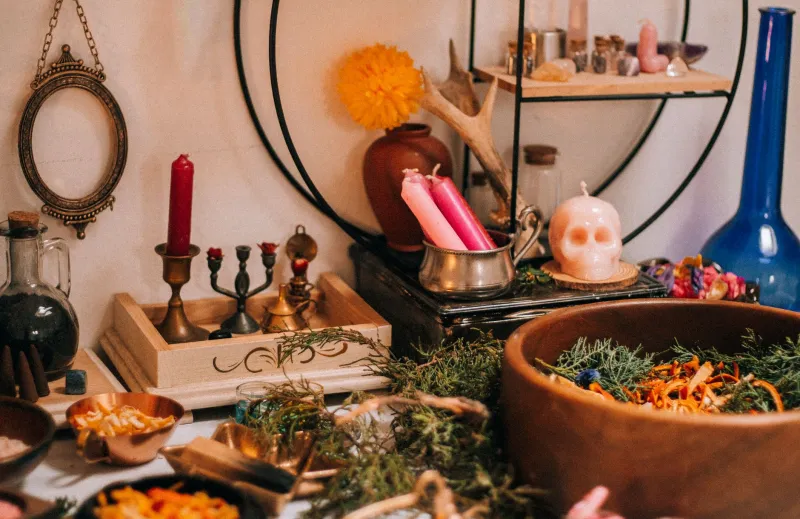
You don't need a dedicated room or even a dedicated table. A shelf, a windowsill, a corner of your dresser — any surface you treat with intentionality becomes sacred space.
Here's what you might include:
Photographs or representations. If you have photos of deceased relatives, these are powerful anchors. If you don't, you can use symbolic representations — a written name on paper, a drawing, a flag or textile that represents a place of origin.
Objects with lineage. Inherited jewelry, old tools, fabric, coins from another country, anything that carries the energy of someone who came before you. If you have nothing inherited, objects that represent your heritage work just as well.
Offerings. Many traditions leave food, water, flowers, or candles for ancestors. Water is considered universally appropriate across many practices — it's a gesture of nourishment and welcome. A glass of clean water on your altar is a simple, cross-culturally respectful offering.
Something living. A plant, fresh flowers, or even a bowl of fruit brings life energy to the space and signals that this isn't a shrine to death but a celebration of the continuity of life.
Light. A candle — white is traditionally neutral and widely used — signals that you are illuminating this space, calling attention to it, making it visible.
Navigating Mixed Heritage Without Flattening It
If you're multiracial or multicultural — and in the United States, a huge number of people are — you might feel the pull to represent multiple lineages on one altar. This is absolutely valid. Your altar can hold complexity. It should hold complexity, because you do.
What it's worth avoiding is collapsing distinct traditions into a single aesthetic mash-up that loses meaning. If one branch of your family is West African and another is Irish, you don't need to pretend those traditions are the same or that you understand them equally. You can hold them separately on the same altar — different sections, different objects — and acknowledge that you're still learning.
You can literally say that out loud. "I don't know everything about where you came from. I'm learning. I'm here."
When the Lineage Is Painful
This is the part that stops a lot of people cold. What do you do when the ancestors you know about were harmful — abusive, violent, complicit in terrible things? What do you do with the parts of your lineage that hurt you or that hurt others?
You are not required to venerate ancestors who caused harm. You are not obligated to place abusers on your altar or to send love to people who don't feel safe to love.
What some practitioners do is distinguish between the elevated ancestors — those who lived with some measure of integrity and love — and the wounded ones who passed trauma down the line. You can choose to work only with the elevated ones, even if you have to reach back further in time to find them.
You can also work with the idea of healed ancestors — the version of your lineage that existed before the wound, the people who, somewhere back in time, lived in wholeness. That is a valid spiritual anchor even when the recent history is complicated.
The Practice Itself
Building the altar is the beginning. The practice is returning to it. Light the candle. Refresh the water. Sit for a few minutes. You don't need formal prayers or scripts — though if your tradition has them, use them. You can simply speak: "I see you. I'm grateful for the life that came through you to reach me."
That's it. That's the whole thing.
The altar isn't a performance. It's a relationship. And like any relationship, it deepens over time, with consistency and presence — not perfection.